
Snow fell wrong that year.
It didn’t sparkle. It didn’t hush. It smothered—thick, gray, and heavy, like the sky was dumping its dead onto the streets. By midnight, the town looked embalmed. Cars vanished. Doorsteps blurred. Footprints filled in almost immediately, as if the ground itself didn’t want to remember anyone had passed.
Inside the houses, parents slept lightly. Children slept lighter.
Except for Jonah Reed.
Jonah lay awake in his bed, staring at the crack in his ceiling that looked like a mouth if you tilted your head just right. He had been doing that a lot lately—finding faces where there weren’t any. He told himself it was nothing. He told himself lots of things.
Downstairs, the Christmas tree glowed softly. Presents waited beneath it, neat and untouched. Jonah had checked earlier. His name was there. Big letters. Red paper.
Santa was still coming for him.
That thought should have been comforting.
Outside, something landed on the roof.
Not a thump. Not a crash.
A weight.
The house groaned, wood complaining deep in its bones. Jonah sat up slowly, heart ticking louder than the clock on his nightstand. Snow slid down the window with a dry hiss, like something breathing through teeth.
Then came the sound Jonah would remember for the rest of the few minutes he had left.
Chains.
Dragging. Slow. Patient.
Santa arrived first.
He always did.
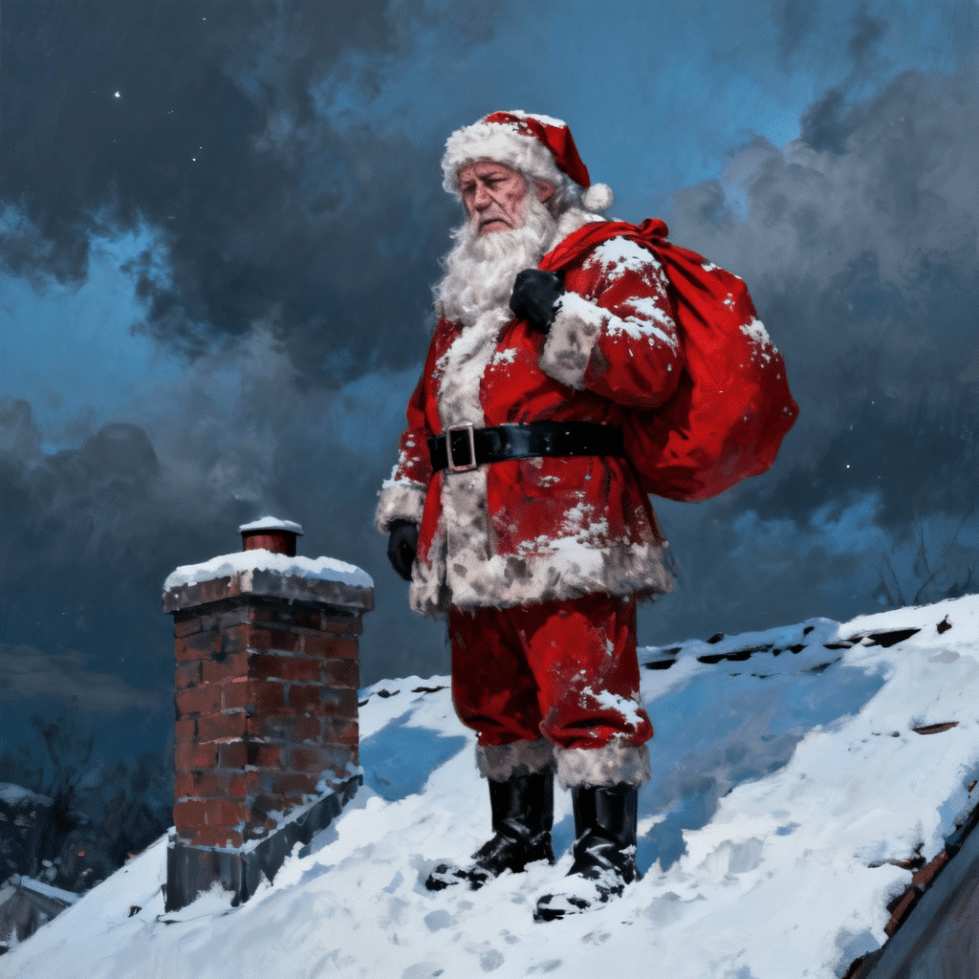
He stood by the chimney, tall and red against the dark, snow clinging to his coat like ash. His face was older than the mall photos suggested—lined, tired, eyes carrying a quiet grief that never fully left. He did not smile when he stepped into the living room. Tonight was not for smiles.
He knelt by the tree and checked the tags one last time.
Jonah Reed.
Santa closed his eyes.
Upstairs, Jonah felt a warmth spread through the house, subtle and brief, like a hand smoothing his hair in apology. He didn’t know why tears welled in his eyes.
Santa placed the gift beneath the tree.
Not coal.
Coal was a warning for parents. A symbol. A lie meant to scare children into behaving.
This gift was real.
It was heavy. Wrapped carefully. Final.
Santa stood, paused, and whispered—not to Jonah, not to the house, but to something listening beyond the walls:
“He’s yours.”
The air behind him ripped open.
Krampus did not enter the house.
He invaded it with movements only a shadow could make, and the temperature collapsed around him—frost exploding across the walls, racing up the banister, crawling over framed photos as the air filled with the stench of wet fur, iron, and old forests where things were buried and never mourned.
Krampus unfolded himself in the living room, horns scraping on the ceiling, chains clinking with every movement. His eyes burned like embers pressed into skull sockets. His claws—long, black, impossibly sharp—were carved with red symbols that pulsed faintly, as if remembering other names.
Santa did not look at him.
Krampus tilted his head, listening.
He didn’t listen for footsteps.
He listened for the sound a soul makes when cruelty becomes permanent.
Upstairs, Jonah felt it—the sudden certainty that hiding no longer mattered. His door creaked open on its own. The hallway beyond was black, deeper than darkness should be, stretching too far.
A shadow climbed the stairs.
Jonah tried to scream.
Krampus’s hand closed over Jonah’s mouth before sound escaped.
The claws burned. The symbols flared.
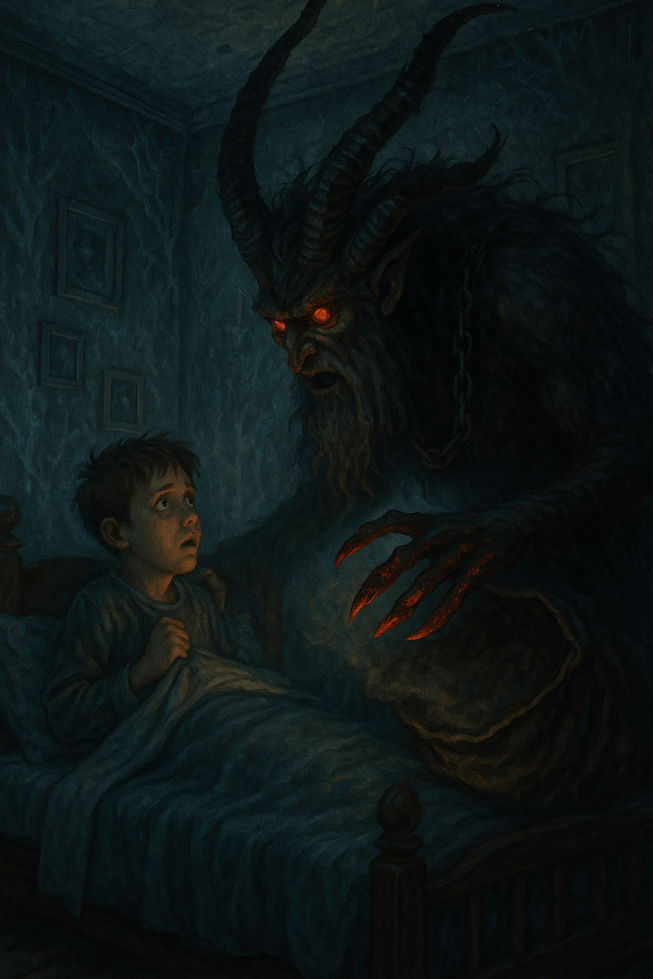
Jonah saw everything all at once: the kid he shoved into traffic, the dog he hurt and told no one about, the lies that destroyed friendships while he watched from a safe distance. Not as memories—but as demons, screaming back at him.
Krampus did not beat him.
He did not roar.
He simply opened the sack.
Inside was not darkness.
Inside was depth, seething with trapped screams, clawing whispers, and the guttural roars of demonic things breathing just beyond sight, their voices vibrating through the fabric like something desperate to tear free.
Jonah felt himself pulled forward, the sack swallowing sound, light, and warmth. The moment his body crossed the threshold, gravity inverted. The world folded inward.
The sack did not carry him.
It delivered him.
Jonah fell.
Not through fire.
Through cold.
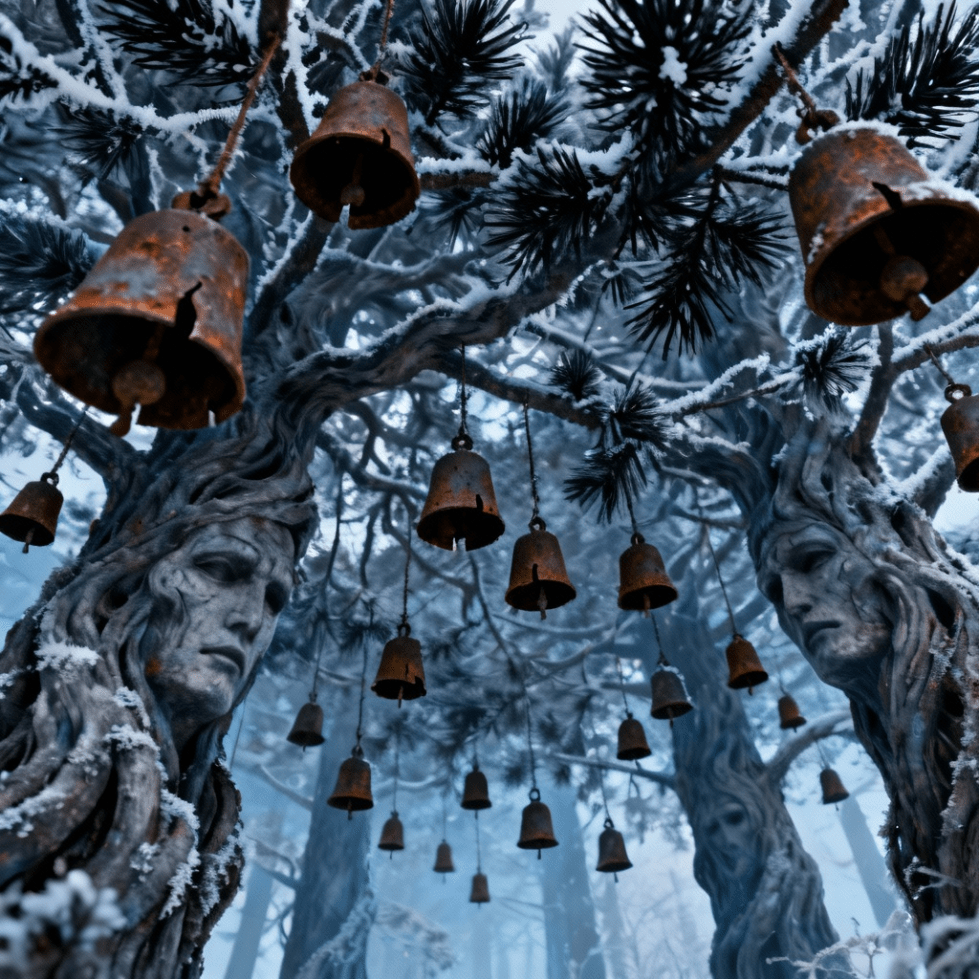
Through a sky without stars, into a vast, endless forest of blackened trees and ringing bells. Each bell chimed a name. Some were screaming. Some were laughing. None were human anymore.
The sack sealed itself.
Krampus straightened.
Santa was already gone.
By morning, Jonah’s bed was empty.
The window was open.
Snow covered the floor.
By noon, his parents were screaming.
By nightfall, the first posters went up.
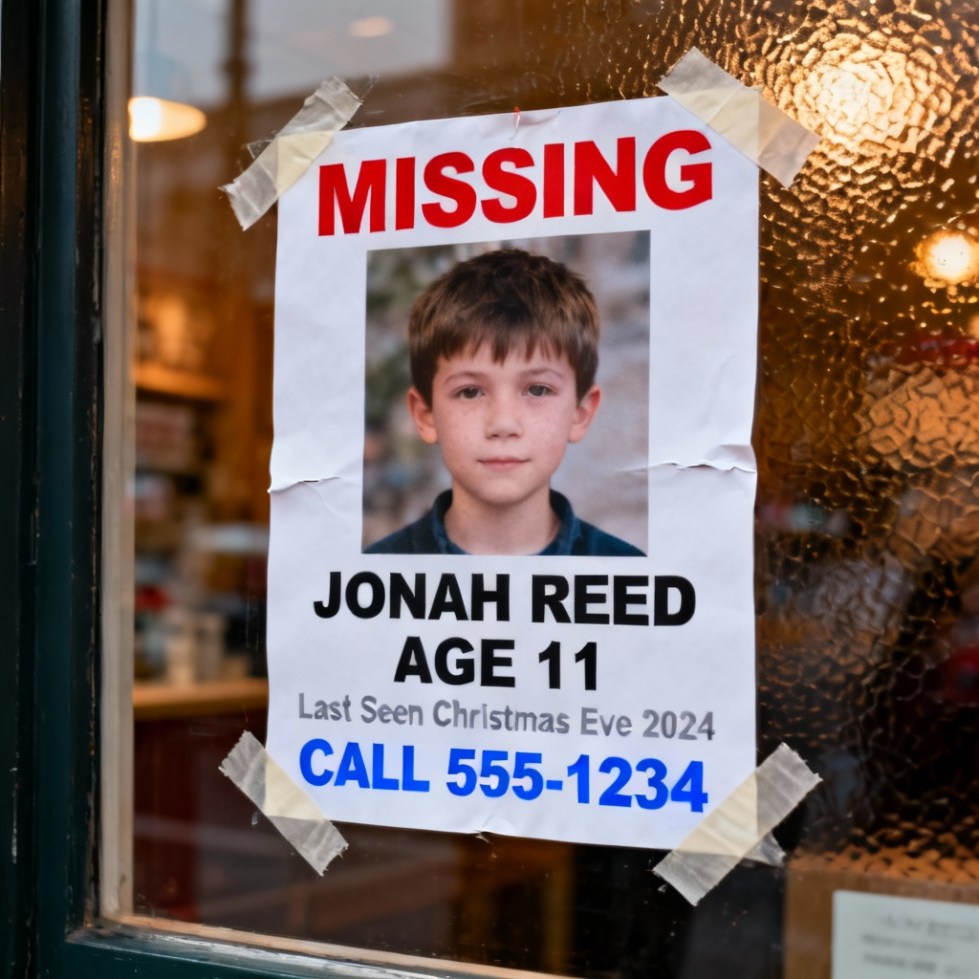
MISSING
JONAH REED
AGE 11
His smile stared out from grocery stores, telephone poles, gas stations. The ink ran when snow melted against the paper. People shook their heads. “So many kids these days,” they said. “So sad.”
No one noticed the faint red symbols burned into the corner of each poster.
And on Christmas Eve, as lights flickered and bells rang, Santa moved on to the next town—
—and Krampus followed. Collecting and rewarding children as they passed.
As for Jonah Reed…
Jonah did not land.
Falling simply… stopped.
Cold closed around him, thick and heavy, pressing from every direction at once. The sack loosened—not opening, not tearing—but unbecoming itself, its fabric thinning into shadow until Jonah was standing on frozen ground that breathed faintly beneath his bare feet.
The screams did not stop.
They moved.
They echoed outward, layered and distant, as if the sack had not released him so much as unfolded into a place.
Jonah tried to inhale.
The air burned. It tasted old—like dust sealed in a basement for centuries, like breath trapped behind stone. Every exhale came out white and trembling. His hands shook so badly he had to clutch his own arms just to feel real.
Then the trees came into focus.
They were tall. Too tall. Trunks twisted into shapes that almost resembled faces, branches tangled together overhead so tightly that no sky could be seen—only a ceiling of black needles and hanging frost. Bells dangled from the branches, hundreds of them, rusted and split, swaying though there was no wind.

They rang softly.
Not at once.
One at a time.
Dong.
A name followed each chime.
A child’s name.
Jonah froze.
To his left, a boy no older than him stood knee-deep in snow, staring straight ahead. His lips moved soundlessly, repeating his own name like a prayer he didn’t believe in anymore. Farther down the path, a girl clutched a torn stuffed rabbit, its head blackened and stiff with ice. She rocked slowly, counting under her breath.
Everywhere Jonah looked, children stood scattered among the trees—some crying, some silent, some staring upward as if waiting for someone to answer.
No one came.
Dong.
Another bell.
Another name.
When Jonah heard it, his knees buckled.
“Jonah Reed.”
The sound did not come from one direction.
It came from the forest itself.
The ground beneath him shifted, guiding him forward whether he moved or not. Snow parted into a narrow path, edges curling inward like teeth. Jonah stumbled, half-walking, half-dragged, pulled toward the sound of his name.
As he passed the others, they reached for him.
Not pleading.
Warning.
“Don’t answer,” one whispered, voice cracked and hoarse. “Don’t let them finish it.”
“What happens?” Jonah cried.
But the child was already fading, his outline blurring as frost crept up his legs, sealing him in place like a statue left unfinished.
The bells rang faster now.
Dong.
Dong.
Dong.
Names layered over names, overlapping until Jonah couldn’t tell where one ended and another began. The forest grew denser, darker. The air vibrated with something low and constant—a growl, not from a single throat, but from the land itself.
Then Jonah saw them.
Between the trees, shapes moved.
Tall things. Bent things. Things with too many joints and mouths that opened sideways. Their eyes glowed dull red, unfocused, uninterested—like livestock waiting to be fed.
Jonah realized, with a sick lurch, that none of them were watching the children.
They were listening.
The bells slowed.
One final chime rang.
Dong.
“Jonah Reed.”
The voice was closer now.
Right behind him.
Jonah turned.
The trees parted.
And something stepped forward to teach him what the sack had truly delivered him to.
Back home…
By the third day, Jonah’s poster had begun to curl.
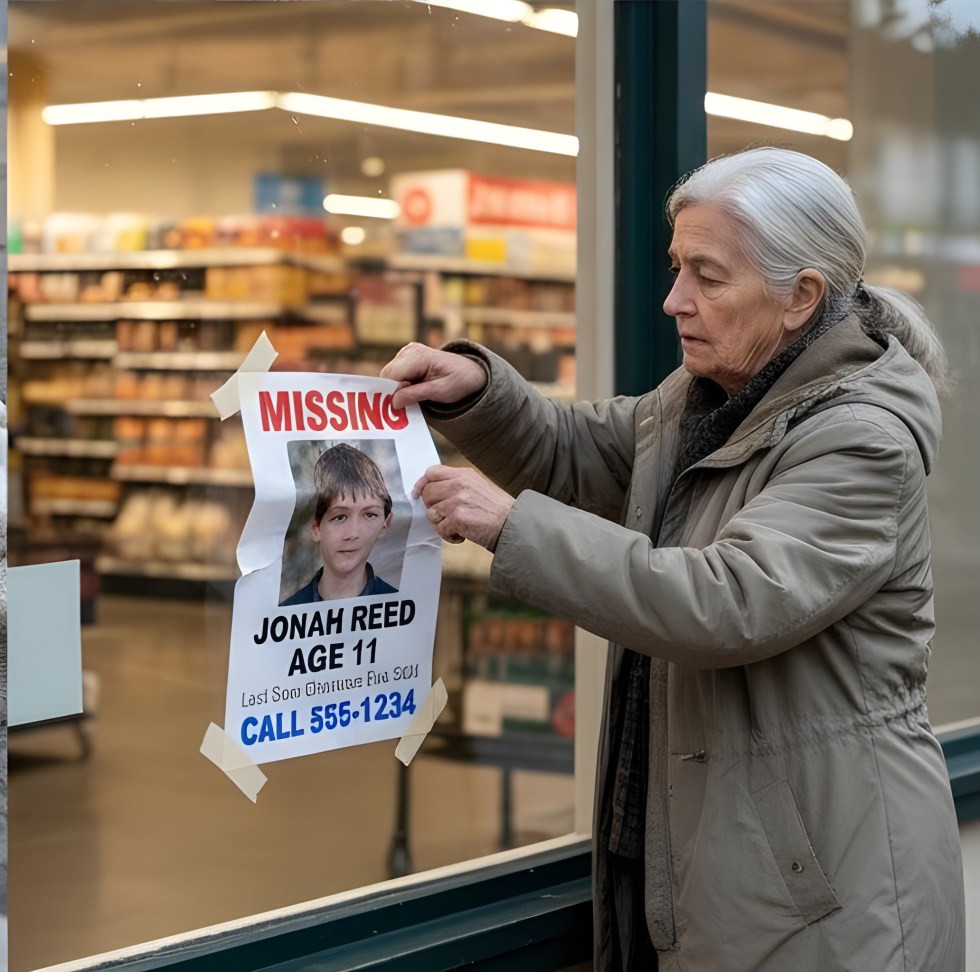
The tape failed first. Corners peeled away from brick and glass, surrendering to damp air and tired hands. Someone tore one down outside the grocery store, muttering that it was upsetting customers. Another came loose from a telephone pole, flapping weakly until the wind ripped it free and carried it into a slush-filled gutter.
His face stared up from the paper—smiling, alive, wrong.
At home, the house no longer smelled like Christmas.
Jonah’s mother sat at the kitchen table, hands wrapped around a mug she hadn’t touched. The coffee inside had gone cold hours ago, a thin skin forming across the surface. She rocked slightly without noticing, eyes fixed on the space where Jonah should have been barreling through the hallway.
His father stood in Jonah’s doorway, unable to cross the threshold.
The bed was still made. The crack in the ceiling still looked like a mouth.
No footprints had ever been found.
The police said he was probably a runaway. Someone suggested trafficking. Someone else said children disappeared all the time.
None of them said Christmas.
That night, Jonah’s sister whispered his name into the dark and waited for an answer that never came.
The bells downtown rang for evening service.
None of them rang for Jonah.
THE FOREST AGAIN
Dong.
“Jonah Reed.”
The forest leaned closer.
The sound pressed into Jonah’s skull, vibrating through his teeth, his ribs, his memories. Everything inside him screamed to answer—to say here, to say I’m listening, to say please stop.
Then he remembered the boy’s voice.
Don’t answer.
Jonah clamped his mouth shut.
He bit down hard enough to taste blood.
The bell rang again, sharper this time, impatient.
“Jonah Reed.”
The snow at his feet crept forward, nudging him toward the path. The trees groaned. Branches flexed like fingers curling.
Jonah shook his head.
“No,” he whispered.
The forest paused.
For the first time since he arrived, something changed.
The bells stuttered.
The creatures between the trees shifted, their low growls deepening—not angry, but… alert. Curious. One of them stepped forward, its shape resolving as it moved into the faint glow cast by the bells.
It had once been a child.
Jonah knew it instantly.
Its body was tall and stretched, joints pulled too far apart, limbs elongated like something grown in the wrong direction. Frost clung to its skin in thick plates, fused there as if the cold had rewritten it. Its face was wrong—features blurred and rearranged, mouth split into a permanent, jagged grin—but its eyes…
Its eyes were familiar.
They were tired.
It tilted its head, listening—not to Jonah’s name, but to his silence.
The bells rang again.
Another child, farther down the path, answered.
A small voice called back—trembling, hopeful.
“I’m here.”
The forest responded immediately.
Roots burst from the ground, coiling around the child’s legs, arms, throat. Bells rang faster, louder, drowning out screams as the snow swallowed the struggling shape. The child was pulled backward, body folding and stretching, bones cracking not with violence—but with a painful purpose.
Jonah watched in frozen horror as the transformation completed.
The screaming stopped.
Another creature rose where the child had been.
It shook itself once, frost sliding from its twisted limbs, and then it turned—not toward the forest, but inward, as if listening to something buried deep inside its own chest.
The bells rang again.
Another child answered.
A thin voice called back, cracking with relief. “I’m here.”
The forest responded.
The ground did not erupt. No roots burst forth. There was no violence in it—only inevitability. Snow closed around the child’s feet like water, then rose, swallowing knees, waist, chest. The bells rang faster, overlapping, drowning out the child’s pleas as the cold climbed higher.

The screaming faded into a sound Jonah had heard before.
Not pain.
Regret.
When the snow settled, nothing remained where the child had stood.
No body.
No bones.
No trace at all.
Jonah waited for something to rise in the child’s place.
Nothing did.
The creature Jonah had been watching lowered its head.
Its body trembled—not with hunger, not with anticipation, but with something close to relief. A long, shuddering breath escaped its throat, fogging the air.
Understanding crept over Jonah slowly, like frost creeping up glass.
The forest did not punish children.
It erased them.
This was not hell as fire or torture. There were no flames, no screams stretched into eternity. This was hell as absence—as the slow stripping away of name, memory, and meaning until nothing remained to be claimed.
The creatures were not what the children became.
They were what remained after.
Hollowed things. Shells shaped by centuries of listening. Not born, not remade—only worn down by proximity to what vanished here. They lingered at the edges, drawn to the bells because the bells were all they had left.
The growling Jonah had heard was not demons.
It was grief that had forgotten how to sound human.
The creatures turned away from Jonah, attention drifting. He had not answered. He had not allowed the forest to take his name.
Not yet.
For a moment—just a moment—the forest seemed uncertain.
The bells slowed.
Dong.
A name rang out somewhere deeper, farther in, and the sound pulled the forest’s attention away from Jonah like a hooked line. Snow shifted. Branches creaked. The bells leaned toward the new voice.
Jonah exhaled, a sharp, shaking breath.

Then the ground beneath him gave way.
Not violently.
Quietly.
Snow softened under his feet, turning suddenly weightless, as if the earth had decided he no longer belonged on its surface. Jonah gasped as he sank knee-deep, then waist-deep, the cold biting through him with a pressure that crushed breath from his lungs.
“No—no, wait—” he choked, grabbing at the air.
The forest did not respond.
The snow swallowed him whole.
Darkness closed in—but not the darkness of the sack. This was thinner, stretched, unfinished. Jonah felt himself pulled sideways, not down, dragged through a narrowing passage that scraped against his skin like frozen fabric.
Then he was somewhere else.
Jonah fell onto stone.
Not snow. Not ice.
Stone—slick and warm, faintly pulsing beneath his palms.
He scrambled upright, heart hammering, and realized the bells were gone.
So were the trees.
He stood in a vast corridor carved from black rock, its walls lined with doors—hundreds of them—each one warped, swollen, breathing faintly in and out. Names were carved into the wood. Some were scratched. Some burned. Some barely visible at all.
Jonah staggered back when one of the doors knocked from the inside.
A child’s voice whispered through the wood.
“Help me.”
Another door began to knock.
Then another.
Soon the corridor filled with the sound—hands pounding weakly, voices pleading, sobbing, bargaining. Jonah covered his ears, but the sound didn’t travel through air.
It traveled through him.
The floor shuddered.
From the far end of the corridor, something moved.
It was not Krampus.
This thing was lower to the ground, its body stretched and boneless, dragging itself forward on too many limbs. Its skin was pale and thin, stretched tight over shapes that moved beneath it. Mouths opened and closed across its body, each one whispering a name.
Jonah’s name.
“Jonah Reed,” it breathed.
Jonah backed away, pressing himself against a door. The wood behind him was warm. Too warm.
The door shuddered.
“Please,” a voice sobbed inches from his ear. “Don’t let it hear you.”
Jonah slid sideways, panic overtaking thought.
That was when he understood.
This was where children went when they didn’t answer.
Not erased.
Stored.
Preserved in fear. In regret. In the endless moment before forgiveness that would never come.
The creature advanced, dragging itself closer, mouths stretching wider.
“You didn’t answer,” it crooned. “So you belong here.”
Jonah screamed.
The sound echoed once—thin and small—then vanished as the creature lunged.
It did not bite.
It opened.
Jonah felt himself pulled apart—not torn, not broken—but spread, his thoughts thinning, his memories loosening like paper soaked too long in water. His name slipped first. Then his face. Then the sound of his sister’s voice.
The corridor dimmed.
The knocking stopped.
Somewhere far above, a bell rang.
Dong.
A name was crossed off a list that no one could see.
By morning, another poster would be taken down.
Another family would be told there were no new leads.
And Christmas would come again.
As it always did.
Leaving fewer names each year.
Want to own this series? Check out the following link to start collecting today!
 Plot🫀Pulse | Short Stories & Blog
Leave a comment