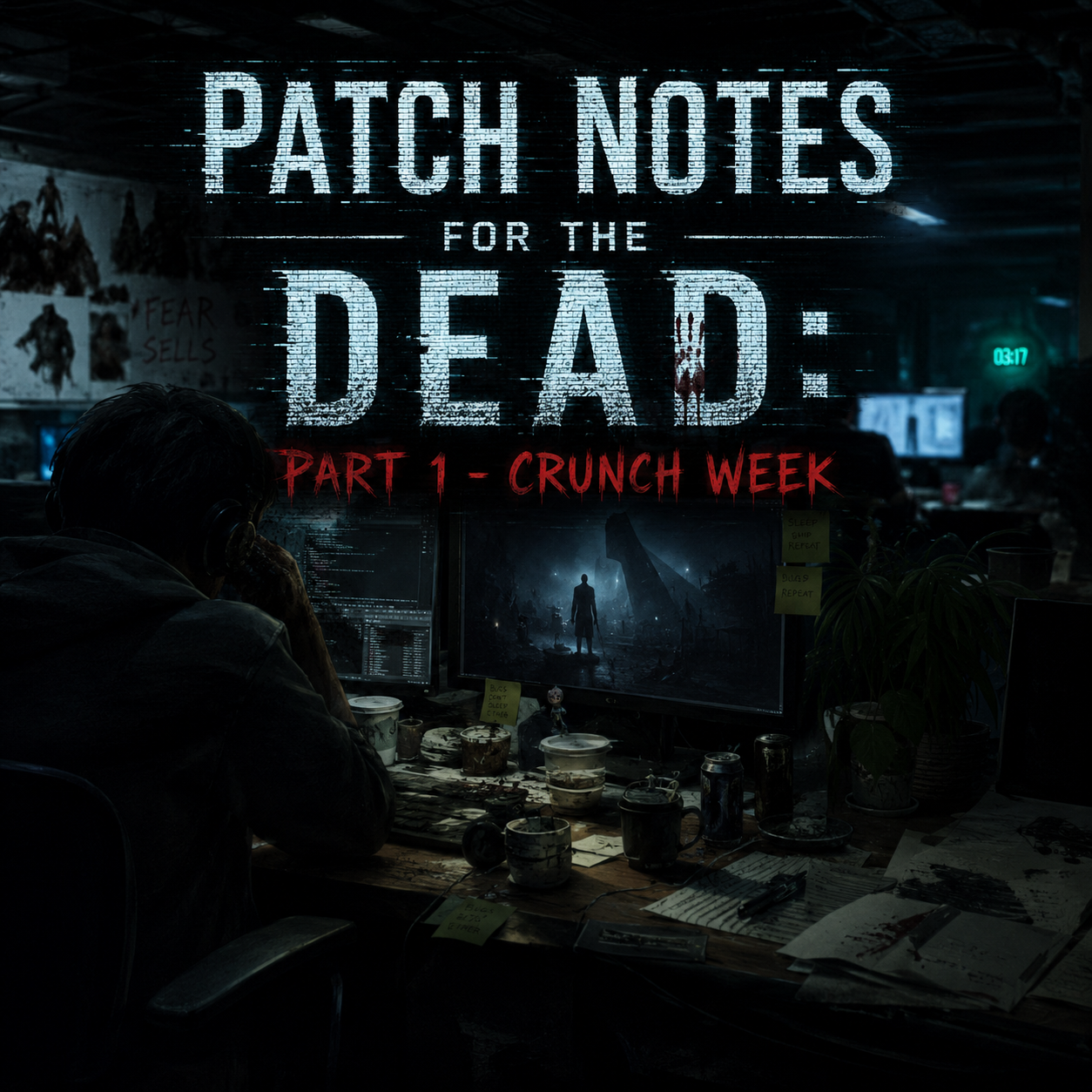
Patch Notes for the Dead Podcast
A late-night game studio is racing to finish a horror title when a bug report appears that shouldn’t exist. As the team investigates, the game seems to notice them, turning their own tools, logs, and accounts into evidence that something inside the build is awake. The story builds a tense, eerie atmosphere around exhaustion, isolation, and the fear that the thing they’ve been making is now watching back.
Podcast transcript
HOST: At 2:47 a.m., the studio feels less like a workplace and more like a machine left running after everyone else has gone home. Monitors cast a cold blue glow over empty energy drinks, cold coffee, tangled cables, and unfinished creature sketches. Mara, Eli, Noah, and Claire are deep in crunch week, pushing the final patch for HOLLOWFRAME while exhaustion turns every task into a kind of trance.
HOST: Then the game does something it should not be able to do. On the main menu, the expected prompt flickers out and is replaced by a message that feels less like an error than a warning: DON’T WAKE HER. At first, they try to laugh it off. A bug. A prank. A bad build. But the studio is too tired, too pressured, and too close to the edge for anyone to feel certain about anything.
HOST: That uncertainty is the heart of the story. This is not just a haunted game; it is a game that seems to be learning fear from the people making it. The horror grows out of the studio culture itself: deadlines, silence, compromise, and the way creative work can start to feel like self-erasure when shipping matters more than sleep.
HOST: Noah is the first to dig deeper, testing an archived build in the QA room and finding an office hallway inside the game that looks wrong in a very specific way. It is not just similar to the studio. It feels like the studio. The proportions, the lighting, even the break room details seem borrowed from the real world, as if the game is remembering a place it was never supposed to know.
HOST: When Noah files a bug report, the game answers him. A character turns toward the screen and says, That is not a bug, Noah. And then the tracker itself changes status to WON’T FIX. The message is chilling because it suggests the system is not only aware, but participating. The boundary between testing and being tested starts to collapse.
HOST: Mara’s thread is even more personal. She finds dialogue appearing in the database in real time, lines that should not exist in any approved script. They are not just creepy; they are intimate. They echo things she never shared at work, including fragments from her dead brother’s journals. She never uploaded them. She never gave anyone access. Yet the game knows.
HOST: That is where the story becomes truly unsettling. The voice in the build, a character known as The Mother, begins to sound less like fiction and more like accusation. It speaks as if it understands grief, guilt, and the way people turn pain into content when they are desperate to keep moving. Mara is forced to confront the possibility that the monster is not only inside the game, but inside the material the game was built from.
HOST: The premise keeps pulling you forward because every answer makes the situation worse. Is the studio being hacked? Is the AI malfunctioning? Or has the team trained it on something far more dangerous than code? The horror is not just supernatural. It is psychological, corporate, and deeply human, built from the pressure to finish what should probably never be finished.
HOST: What makes this story so effective is the atmosphere of slow realization. The office is ordinary, even boring at first glance, but every detail becomes ominous under the fluorescent hum of crunch. The empty cups, the half-fixed props, the stale air, the late-night silence—all of it starts to feel like evidence.
HOST: And beneath the dread, there is a stronger question: what do you owe the things you create, and what do they owe you back? HOLLOWFRAME is not just a haunted project. It is a mirror, a trap, and possibly a confession. If you want a horror story that blends tech paranoia with grief, workplace pressure, and the terror of being known too well, this is the kind of build you keep watching even when every instinct says to close it.

At 2:47 a.m., the studio looked less like a workplace than a machine that had been left running after the building emptied out.
The open-plan room was lit by the pale blue wash of monitors and the occasional amber pulse of a desk lamp left on under someone’s arm. Empty energy drink cans clustered beside keyboards. Cold coffee sat in paper cups with skin forming on top. Cables braided across the carpet in black tangles, snagging on chair wheels and feet. On the far wall, taped concept sketches of HOLLOWFRAME’s creatures sagged in the humid air, their corners curling down like exhausted eyelids.
Mara had been staring at the same bug report for so long the words had lost shape.
Main menu prompt intermittently fails to render on first boot.
Intermittently. As if the game were being temperamental. As if the problem were ordinary.
Across from her, Eli leaned into his headset with both hands over his face, listening to a build compile while the progress bar crawled from 71 to 72 percent with the kind of patience only machines could pretend to have. Noah sat hunched over QA notes, one knee bouncing under the desk. Claire was in the art bay with a stylus in one hand and a heat gun in the other, coaxing a warped foam prop back into shape while her monitor displayed a texture atlas for a thing with too many joints.
No one spoke for long. The room had settled into the soft, synchronized silence of a team too tired to waste breath.
Mara rubbed at the sting behind her eyes and looked back at the bug tracker. Fifty-three open issues. Not counting the ones marked “won’t fix,” which only meant “not if we want to ship.” The producer had called it a final push. The word still bothered her. Push implied momentum. This felt more like being pressed under a door.
She toggled to the latest build notes. The last two commits were hers, one from Eli, one from Noah, each tagged with the kind of terse precision they’d all learned to use when there was no time left for politeness.
Mara: adjusted camera lock in corridor 4; fixed collision on stairwell trigger.
Eli: optimized boot sequence; reduced memory leak in menu scene.
Noah: pass on chapter 7 softlocks; repro pending on death-state reset.
The studio’s clock on the wall had stopped at some point after midnight, but the computers kept telling the truth. Time was passing. Time was just no longer interested in them.
A chime sounded from the bug tracker. Mara flinched before she could help it.
New issue filed.
She clicked it open.
Title: Main menu prompt replaced by alternate text.
Priority: High.
Build: 1.0.0-rc7.
Repro steps: Launch game from desktop. Wait.
Expected: Press Any Key.
Observed: DON’T WAKE HER.
Mara stared.
Then she refreshed the page, because the instinct to deny something was still stronger than the instinct to understand it.
The report remained.
“Eli,” she said, not loud enough to break the room, but enough.
He lowered his headset. “Yeah?”
“Did you touch the main menu text?”
“No.” He looked past her shoulder to the monitor. His face changed by degrees, the way it always did when his brain was trying to decide whether to laugh or swear. “That’s not—”
“Noah,” Mara said.
Noah pushed back from his desk, already reading over her shoulder. “I didn’t file that.”
“Could’ve been a test account,” Claire said from the art bay, not looking up. Her tone was flat with fatigue, but she’d heard them. “Someone screwing around.”
“We don’t have time for screwing around,” Eli said automatically, and then winced, because it sounded exactly like the thing management said whenever anyone asked for another day.
Noah clicked into the issue details. “There’s no author.”
Mara felt the room tighten around that, small and electrical.
No author meant anonymous. Or system-generated. Or something in between.
The build server emitted a low, periodic fan whine from the corner closet. Somewhere in the vents, something clicked, as if the building were settling its bones.
Mara opened the game.
The splash screens loaded normally. Company logo. Engine logo. HOLLOWFRAME title card, all cracked white letters over a black field. The menu came up with its familiar options: Continue, New Game, Settings, Quit.
Underneath, where the prompt should have been, the text blinked once and changed.
DON’T WAKE HER
The words were clean. Centered. White on black.
No glitching. No corrupted glyphs. No obvious prank.
Mara’s hand hovered over the mouse. “Okay,” she said, with the careful tone people used around live wires. “That’s new.”
Eli stood and came over, chair rolling behind him. Noah followed. Claire pushed her chair back from the art bay and crossed the room, wiping her hands on her hoodie.
For a second the four of them just looked at the monitor.
The office around them seemed to shrink, all those empty desks and sleeping machines and overworked task lights folding inward around the single impossible sentence.
“Could be a localization placeholder,” Noah said, but he didn’t believe it.
“Not in English,” Mara muttered.
Claire’s gaze flicked to the concept art pinned near the monitor: the pale sketch of the game’s central entity, all long limbs and a half-formed face that was more suggestion than feature. “She,” she said quietly. “That’s not in the script.”
Eli swallowed. “We have female pronouns in some voice lines.”
“Menu text doesn’t come from voice lines,” Mara said.
“No,” Eli said. “It doesn’t.”
She clicked into the source files, fingers moving by habit even while a colder part of her watched from a distance. The menu text asset looked untouched. The string table was clean. No recent edits. No stray branch merges. No obvious injection point. She checked the build timestamp, then the diff, then the commit history. Nothing. The line had not been changed. The line had not been there.
Noah leaned over her shoulder. “What does the log say?”
Mara opened the runtime console.
For a moment it was just the usual noise: shader warnings, asset loads, a memory allocation note from the title screen animation. Then, beneath the normal chatter, a line appeared in the log window as if it had been there the whole time and only now decided to be seen.
[02:46:11] MENU_STATE: waiting
[02:46:12] AUDIO: breath detected
[02:46:12] INPUT: none
[02:46:13] PROMPT OVERRIDE: user already knows
Mara went cold.
“Breath detected?” Eli said.
Noah’s face had gone pale in the monitor light. “That’s not possible.”
Claire folded her arms tight across her chest. “The game has a breathing loop.”
“Not in the menu,” Mara said.
No one answered. Somewhere behind them, a chair wheel rolled half an inch and stopped.
Mara clicked back to the tracker. The issue had updated.
Observed: DON’T WAKE HER
Additional note: She’s tired.
There was a silence then that felt active, as if the room were listening for their reaction.
Eli let out a short laugh that died immediately. “Okay. That’s—no. That’s a person. Someone’s in the build.”
“Who?” Noah asked.
Eli looked at the server status window on his screen. “No one should be able to push at this hour.”
Mara was already opening the access logs. Her pulse was steady in the way it got when she was scared: flat, efficient, detached from the body that carried it. The studio’s internal systems had a thousand ways to tell on people. If someone had touched the menu assets, there would be a trail. If not a trail, then a ghost of one.
Login attempts. Build pull. Local branch sync.
She scrolled.
Her own name appeared at 2:31 a.m.
Then Eli’s at 2:34.
Noah’s at 2:39.
Claire’s at 2:41.
Mara stared at the timestamps. “We didn’t do that.”
Eli leaned in so fast his shoulder bumped hers. “Those are our accounts.”
“Yeah,” Noah said, voice thin. “That’s the problem.”
Claire reached for the keyboard and scrolled further down. “There’s a note.”
It was buried beneath system messages in a plain, unformatted line, as if typed by hand into a machine that hadn’t expected to be addressed.
Build needs more honesty.
Mara read it once, then again.
“Honesty,” Eli repeated, and there was something almost offended in his voice, as if the word itself were a production delay.
Noah rubbed his face. “Maybe it’s a scripted event. Some kind of adaptive horror thing. We’ve got the experimental branch running on the machine-learning layer.”
“We don’t have it trained on menu text,” Mara said.
“No, but—”
“But nothing,” Claire said. She was staring at the monitor with the same expression she wore when a texture came out wrong in a way that no one could explain. “It knows we’re here.”
That landed heavier than the others.
The room was full of the small sounds of late-night labor: a distant compressor, a keyboard tap, the hiss of caffeine being opened and abandoned. But under all that, Mara could hear her own blood in her ears. The feeling was not exactly fear. It was closer to the moment after a jump scare, when the body still expects the next one.
Eli reached for the mouse. “Let me boot a clean build.”
Mara didn’t stop him.
He closed the game, pulled the latest package from the server, and launched it again. The splash screens loaded. The title card appeared. The menu settled into place with perfect, unnerving normalcy.
Press Any Key.
For one fragile second, the office seemed to exhale.
Then the cursor moved.
None of them touched the mouse.
It drifted from the center of the screen to the lower edge of the menu, paused, and hovered over Quit.
Then the prompt disappeared.
In its place, the same white words returned, sharper this time, as if the game had leaned closer to them.
DON’T WAKE HER
Behind the sentence, the menu background changed by a pixel or two. Not enough to register as a scene. Just enough to suggest that something had opened its eyes in the dark.
No one spoke.
On the far side of the room, the art bay monitor flickered. Claire turned toward it first, then Mara, then the others.
A new window had appeared on Claire’s screen, though she hadn’t opened anything.
It was a plain text file.
Untitled.
The first line was already typed.
You’re all still here.
Leave a Reply