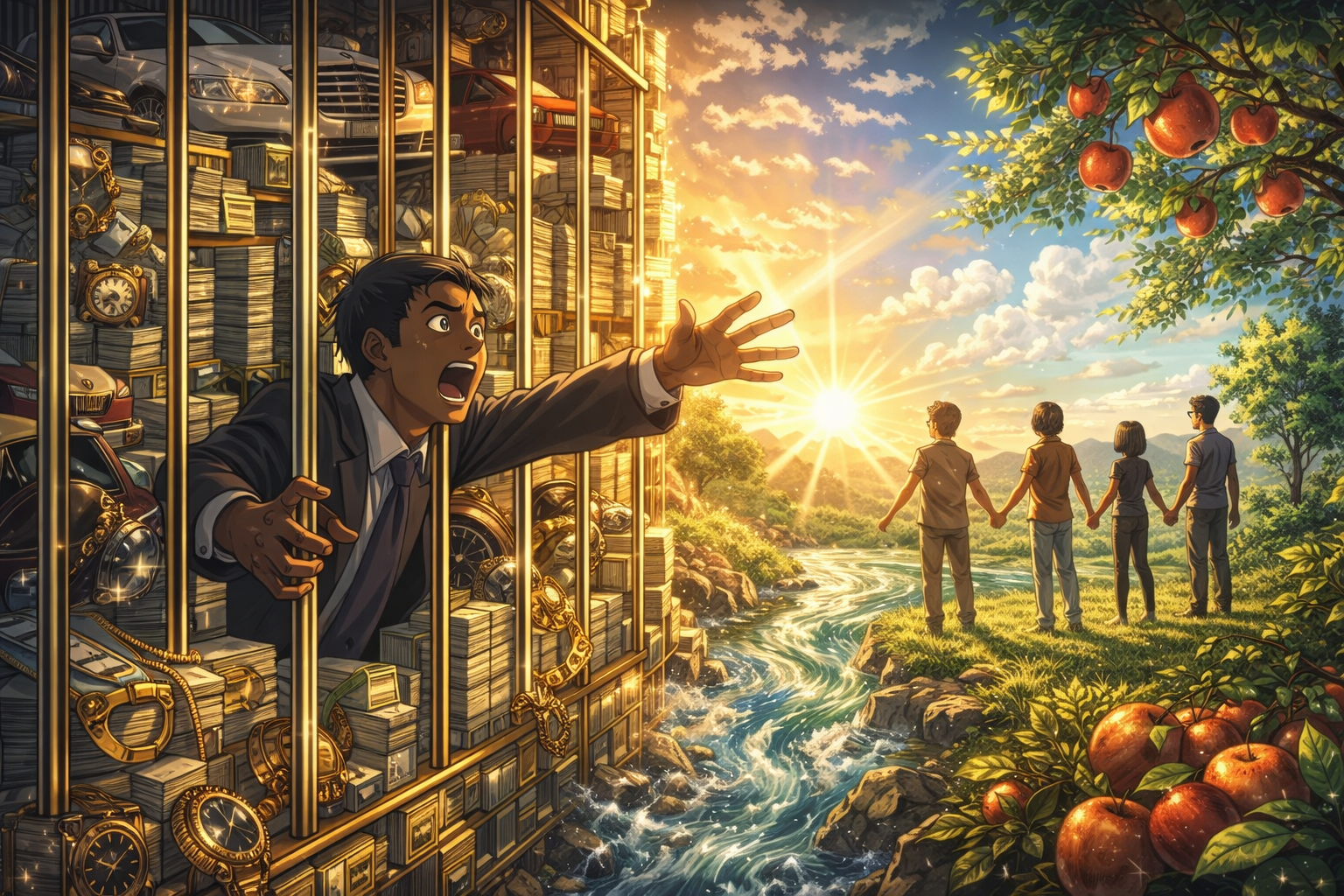
From the moment we are born, we are quietly introduced to an idea that shapes almost everything around us:
Materialism.
It’s not presented as a philosophy.
It’s presented as normal life.
We grow up learning that success means owning things.
A bigger house.
A newer car.
More expensive clothes.
More upgrades.
The message is subtle but constant:
Your worth is tied to what you can acquire.
And underneath all of it sits the system that powers this belief:
Money.
The Money = Survival Illusion
Most of us are raised to believe one fundamental rule:
Money equals survival.
Without money, you can’t live.
You can’t eat.
You can’t have shelter.
You can’t participate in society.
So from childhood, we are trained to chase it.
School prepares us to work.
Work earns money.
Money buys the things that supposedly give us stability and happiness.
But if you step back and look at the bigger picture, something strange becomes clear.
Money itself has no real value.
It’s not food.
It’s not water.
It’s not air.
It’s simply a symbol we collectively agreed to treat as valuable.
What Humans Actually Need
Strip life down to its most basic requirements and the list becomes surprisingly small.
Humans need:
- Air
- Water
- Food
- Shelter
- Community
That’s it.
Everything else — most of what we spend our lives chasing — is built on top of those fundamentals.
And the interesting part?
Most of those essentials exist naturally in the world.
Air is free.
Water falls from the sky.
Food grows from the ground.
The planet itself produces the resources needed for life.
So Where Did It All Change?
Over time, societies created systems to organize resources.
At first it was simple trade.
Then currency.
Then complex economic structures designed to manage production, ownership, and distribution.
Eventually, the system evolved into something far more powerful.
Today, access to basic necessities often requires participation in the economic machine.
Even when the resources themselves exist naturally.
The Cost of a Materialistic System
When survival becomes tied to money, something else happens.
People begin to equate financial success with personal value.
You see it everywhere:
People working jobs they hate just to keep up.
Stress replacing fulfillment.
Endless consumption replacing meaningful experiences.
The system rewards productivity and accumulation.
But it rarely asks a deeper question:
Is this actually making life better?
A Different Way to Look at Life
None of this means society should abandon structure or cooperation.
Systems exist for a reason.
But it’s worth questioning the assumption that material accumulation equals happiness or security.
Because when you look closely, many of the most meaningful parts of life aren’t things you can buy.
Connection.
Purpose.
Creativity.
Love.
Time.
None of those things can be stored in a bank account.
And yet they are often the things people value most at the end of their lives.
One Final Question
Before you move on from this post, take a moment to ask yourself something honestly.
Are you chasing money… or are you chasing the life you actually want?
For many people, the pursuit of money becomes the central focus.
Promotions.
Overtime.
Side hustles.
Investments.
Always pushing for the next financial step forward.
But here’s the uncomfortable part.
Sometimes the chase becomes so consuming that it blinds us to other opportunities.
Opportunities for creativity.
Opportunities for meaningful work.
Opportunities for connection.
Opportunities for experiences that can’t be measured in dollars.
If every decision is filtered through the question:
“Will this make me more money?”
Then entire paths in life quietly disappear before we even notice them.
And the strange irony?
For many people, the harder they chase money, the more it seems to stay just out of reach.
Like a finish line that constantly moves further away.
So here’s the real question:
Do you chase money?
And if you do…
Does it ever feel like no matter how hard you push, it still never feels like enough?
Maybe the answer isn’t just working harder.
Maybe the answer is stepping back and asking a deeper question:
What are you actually trying to buy with money in the first place?
Because once you know that, you might realize something important.
Some of the most valuable things in life were never behind a price tag to begin with.
Final Thought
The real question isn’t whether money exists.
The real question is whether we allow it to define the entire meaning of life.
Because at the end of the day, the things we truly need to survive — and the things that make life worth living — are often the very things that were never meant to be bought or sold in the first place.
Leave a Reply